The C.O.R.E. Method
Clearing Overwhelming Retained Experiences
Autonomic Discharge & Somatic Restoration — Hypno Coach Youssef
Click on the image to zoom in
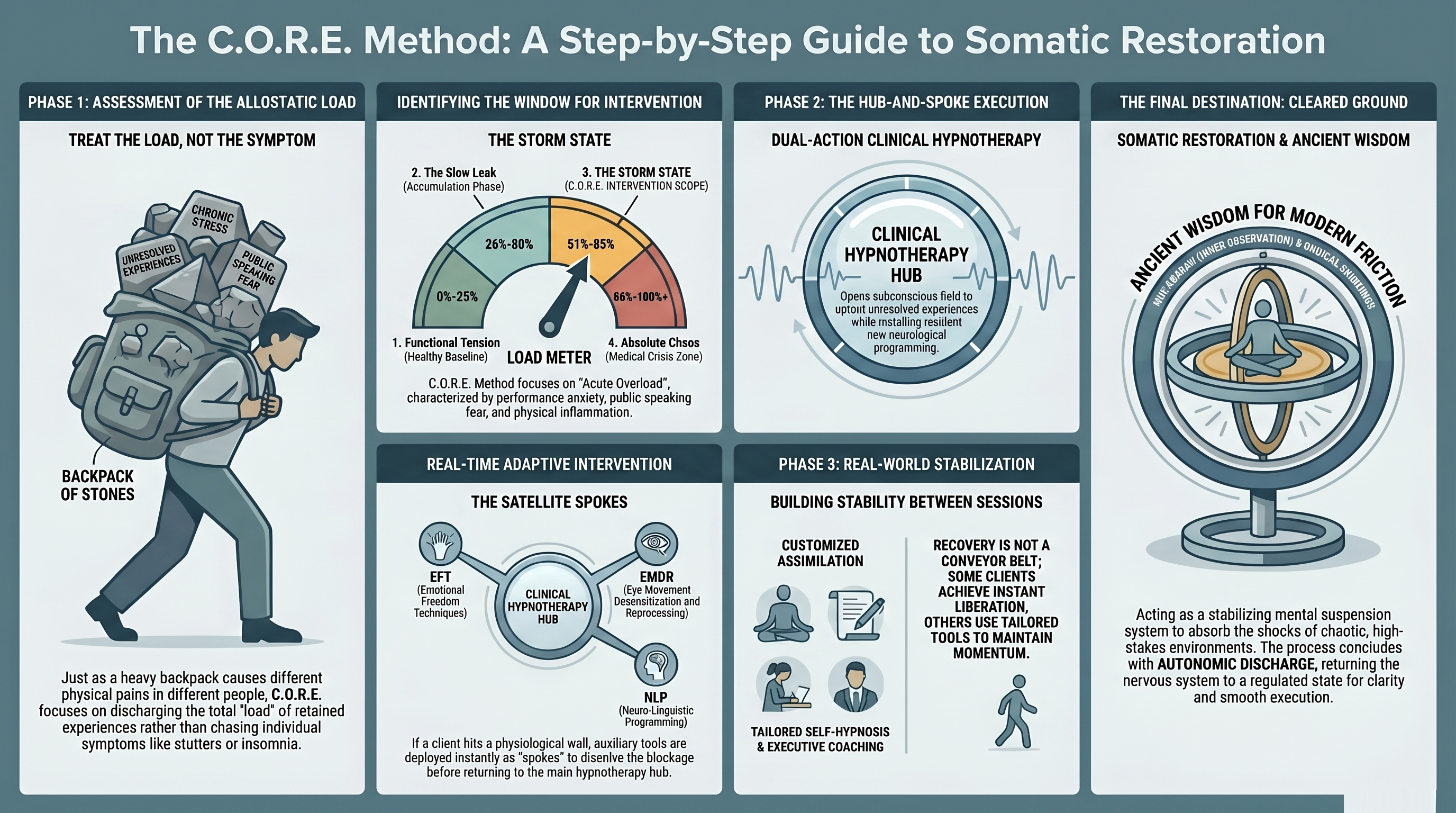
This work, as developed and practiced by Hypno Coach Youssef, begins with a single, non-negotiable premise: the body is an intelligent system that accumulates allostatic load. What conventional frameworks label as symptoms, disorders, or dysfunctions are, in this view, the body’s faithful attempt to manage an overflow of unprocessed experience. The method rejects the primacy of diagnostic labeling, viewing traditional classifications not as distinct pathologies, but as varied expressions of a singular somatic overload. The objective is therefore singular — to facilitate somatic discharge so that autonomic homeostasis can restore itself, or, in the case of developmental trauma, to actively establish those fundamental regulatory pathways for the first time.
The Nervous System Threshold Model
There is no universal standard for how much load a nervous system can bear. Inner resilience, upbringing, skill sets, strength of will, and present life circumstances all shape that capacity. What overwhelms one person may be manageable for another; what one body discharges in days may take another years to release. Understanding this variability is essential, because it explains why the same event can devastate one individual while leaving another relatively unscathed, dependent entirely on their preexisting allostatic load.
To make this visible, the model maps four distinct levels of nervous system load relative to the Window of Tolerance — the optimal zone of autonomic regulation. It must be understood that these are not singular fixed points, but scales — continuous ranges that could, in theory, be subdivided into infinitely finer gradations. The boundaries between them are porous, and an individual may rest near the upper edge of one range while intermittently dipping into the next. The four-tier structure is a practical map, not a rigid taxonomy. Each level represents a different relationship between the amount of unprocessed experience stored in the body and the system’s ability to regulate itself.
Level 1 — Functional Tension (The Manageable Load)
This is the foundational baseline of a healthy, living system. It is the band of manageable stress that keeps a person awake, alert, and functioning in the real world: noticing the crosswalk, remembering what is in the oven, meeting a deadline, navigating traffic. This is the optimal load within the Window of Tolerance — the precise, biological tension that makes the nervous system responsive without breaking it. It is the zone of ordinary competence, where the body and mind work exactly as intended.
Metaphor: a guitar string tuned to perfect pitch; an engine idling smoothly; a security guard attentive at his post.
Level 2 — The Slow Leak (Slightly Above Manageable)
Once the load rises above the manageable threshold, small issues begin to surface. The elevation is subtle — often dismissed as fatigue, mood, or circumstance. The system still functions, but its margin for error begins to shrink. The person may sleep a little less soundly, feel slightly more irritable, or notice a vague sense of being “off” without being able to name it. The damage is present but not yet visible.
Metaphor: a tire with a slow puncture — the car still drives, but the steering feels off and the ride gradually worsens; a pot with a hairline crack — it holds water, yet the seepage is constant and unrelenting.
Level 3 — The Storm State (Sympathetic Hyperarousal)
At this elevation, the body enters a near-constant fight-flight-freeze response characterized by severe sympathetic hyperarousal. The longer a person remains here, the more destructive the state becomes — physically, emotionally, and cognitively. The individual automatically begins seeking coping mechanisms, and because the nervous system is in survival mode, those mechanisms are typically unhealthy: substances, compulsive behaviors, dissociation, or emotional shutdown.
The body becomes hyper-susceptible to both external and internal assaults. Immune function drops. Inflammation rises. Sleep architecture fragments. Concentration evaporates. Natural energy levels collapse. Memory becomes unreliable. Hypersensitivity spikes. The will itself begins to erode. Much of this damage is interior, which means the person often does not recognize the severity of the state until they have lingered in it for a considerable time.
This is precisely why many direct healing methods fail to produce results. The nightmares, the addictions, the loss of focus, the hypersensitivity, the fear of public speaking — these are not root problems. They are surface signals generated by a body trapped in the Storm State. Attempting to treat the signal while ignoring the load is like painting over mold.
Metaphor: A sovereign nation under martial law — all resources are diverted to the borders, while internal infrastructure quietly starves.
Level 4 — Absolute Chaos (System Breakdown)
Beyond the Storm State lies total system breakdown. At this level, medication and extreme invasive interventions are typically necessary. This is not a domain where hypnotherapy is deployed. Hypnosis is reserved for the Storm State and everything beneath it — the space where the load is heavy but the system has not yet collapsed.
Metaphor: a dam breaking; a total system crash; a house fully engulfed — one does not redecorate the living room while the roof is on fire.
What the Method Addresses
The presenting issues that bring a person to this work are not the problem. They are the evidence. A fear of public speaking, a stutter that worsens under scrutiny, a sexual response that has gone numb, a confidence that evaporates in rooms where it is most needed, an addiction that returns no matter how many times it is quit, a trauma that replays in dreams and body sensations years after the event — these are not separate pathologies requiring separate diagnoses. They are distinct signatures written by the same underlying condition: a nervous system operating beyond its threshold, storing experiences it has not been able to process, and expressing that storage through whatever channel happens to be most available to that particular body.
The origin of these signatures is not always somatic. Often the initiating event is mental, emotional, relational, or even existential — a humiliation, a loss, a violation, a prolonged period of powerlessness. But the body is the vehicle through which we exist, and it is the body that ultimately registers and retains what the mind cannot fully digest. The somatic dimension is therefore not one category among many; it is the common denominator. Every mental storm that does not find resolution leaves a physical trace. Every emotional surge that is suppressed rather than expressed becomes a point of tension, a fragment of frozen activation, a piece of the load.
The method treats the following, not as isolated disorders, but as surface expressions of a deeper accumulation:
- Trauma — single-incident or developmental, held as uncompleted defensive responses and unprocessed emotional charge
- Addiction — compulsive patterns functioning as self-medication for a body that cannot settle
- Fear of public speaking — social performance anxiety rooted in stored threat responses that generalize to visibility and judgment
- Stuttering — a speech-motor system interrupted by autonomic activation that overrides fluent execution
- Confidence deficits — an identity structure undermined by a body that has learned to expect collapse rather than support
- Sexual issues — a capacity for intimacy and pleasure blocked by stored shame, threat, or dissociation held in the somatic field
The unifying thread is not the symptom, but the state. All of these expressions emerge from the same territory — the space between the Slow Leak and the Storm State, where the body is full enough to malfunction but not yet empty enough to heal. The work does not treat the list. It treats the load.
How the Method Works
The mechanism is not mysterious. When an experience exceeds the nervous system’s capacity to process it in real time, the body does the only thing available: it stores what it cannot clear. This stored material — whether it manifests as compressed emotional charge, body-held tension, or inner congestion — is not the enemy. It is simply unfinished business that has outpaced the system’s natural allostatic reduction rate.
The method enters this stored field directly. Through clinical hypnotherapy, the client is guided into a state where conscious defenses relax and the body can speak. What emerges is not analyzed or interpreted into oblivion; it undergoes neurological titration and discharge. The nervous system is supported in completing the defensive and emotional responses that were frozen at the time of the original experience.
Once that weight is lifted, the body requires no further instruction. It remembers how to sleep, how to concentrate, how to regulate emotion, how to choose rather than react. This explains why resolutions that previously failed — the decision to stop smoking, to speak with confidence, to love oneself — suddenly take hold. The subconscious mind is no longer fighting against a saturated system. It is operating on cleared ground.
Because the human being is not one thing, the work cannot be one thing. A person who arrives with a stutter may be holding a childhood humiliation in the throat. A person who cannot sleep may be carrying a grief that has never been allowed to move. A person who fears public speaking may have a nervous system that learned, early and thoroughly, that visibility equals danger. Each case requires a different doorway. Coach Youssef meets the body where it lives — in image, in sensation, in breath, in memory, in belief.
Rather than deploying isolated techniques, the C.O.R.E. Method functions as a highly personalized, non-linear clinical matrix. Clinical hypnotherapy serves as the central hub of this framework, performing a dual function: uprooting the unresolved, stored trauma and installing new, healthy neurological programming. Auxiliary modalities — spanning EFT, EMDR, NLP, CBT, and targeted coaching tools — are not applied in a rigid sequence. Instead, they act as dynamic spokes, deployed by Coach Youssef in real-time to contribute to the hypnotherapeutic core whenever a specific physiological block requires immediate clearing.
The Integration Phase: Assimilation & Contemplative Wisdom
Discharging the autonomic load is the acute phase of the C.O.R.E. Method, but the total arc of recovery is intensely personalized, dictated by how close the client is to liberation and the degree of active effort they are willing to invest. For some clients whose systems are heavily primed, a single clinical session provides total somatic release with zero post-session guidance required. For others, sustaining that relief demands rigorous hand-holding and active integration over longer periods of time.
When ongoing support is necessary, the clinical session facilitates the acute physical release, but true emotional and physiological stability is secured in the spaces between sessions. Supported by Coach Youssef through continuous coaching guidance, the client assumes active responsibility for their healing. They utilize self-hypnosis exercises and targeted somatic practices to ensure their newly regulated nervous system does not revert to old, exhausted survival habits.
To protect this newly installed programming, the post-session integration phase draws deeply on the contemplative wisdom of the MENA (Middle East and North Africa) region and Islamic psycho-spiritual frameworks. These principles — such as Muraqabah (deep internal observation) and radical surrender — are not deployed to overwrite or install new beliefs; the clinical hypnotherapy has already achieved that. Rather, they act as a stabilizing gyroscopic force for the client’s daily life. Operating as an active guide outside the clinical hour, Coach Youssef translates these historic principles into practical, everyday anchors that absorb the friction of high-stakes environments. They smooth the ride of existence, maintaining the momentum of the wheel of life so the newly regulated nervous system does not lose its balance. Applied functionally rather than dogmatically, this lineage provides a gravity-tested suspension system for clients of any secular or spiritual background, ensuring that the profound physical shifts achieved within the session successfully translate into enduring behavioral and existential peace.
The Therapeutic Container & Delivery
The efficacy of this rigorous clinical methodology relies not just on the tools applied, but on the absolute integrity of the therapeutic container. Coach Youssef delivers this method both in person from his base in Agdal, Rabat, Morocco, and online to clients worldwide. Operating globally through Sdiddi Counseling Center LLC, a Wyoming-based entity, he works with individuals across continents and time zones. The therapist functions as an autonomic guide, and the closer the client moves toward liberation, the more rapidly somatic discharge unfolds. Geography is strictly secondary to the quality of the therapeutic container.
Content and services are offered in three languages — native Arabic (Darija), fluent French, and fluent English — reflecting the practitioner’s own trilingual fluency and the diverse communities he serves. Whether the session is conducted in Darija for a local Moroccan client, in French for the diaspora in Europe and North America, or in English for global corporate and professional markets, the method remains the same. The body speaks before language does.
Why Healing Cannot Be Formulaic
There is no equation for human recovery. A person brings their entire history into the room — the temperament they were born with, the home they grew up in, the losses they have absorbed, the strengths they have built, the current pressures that deplete them, the beliefs they hold about what is possible. Because of these distinct physiological and psychological layers, treatment length and support requirements are entirely adaptive. Some require extensive hand-holding and prolonged guidance to navigate their newly regulated nervous system, while others step into complete autonomy immediately. The practitioner does not fix the client with a one-size-fits-all timeline. He creates the precise conditions in which the client’s own system can discharge itself and remember how to regulate.
Certified Modalities
Hypno Coach Youssef draws on the following credentials and certified trainings:
- NGH Certified Hypnotherapist — National Guild of Hypnotists
- NBCCH Clinical Hypnotherapist — National Board of Certified Clinical Hypnotherapists
- UK Hypnosis Academy Kinetic Shift Practitioner
- EFT Practitioner — Emotional Freedom Techniques
- NLP Practitioner — Neuro-Linguistic Programming, Sdiddi Counseling Center LLC
- CBT Practitioner — Cognitive Behavioral Therapy, Sdiddi Counseling Center LLC
- Hypnosis Practitioner Training
Professional Foundation
The method did not emerge from a single training. It was forged across a career that moved from the outer edges of human communication to its deepest interior.
The foundation was laid in clinical speech-language pathology at ENP Rabat, where the final thesis focused on parental guidance — the study of how caregivers shape, and sometimes constrain, a child’s developing voice. This early work revealed a pattern that would recur throughout Coach Youssef’s career: the surface problem (a child’s difficulty speaking) was rarely the root problem. More often, it was a relational dynamic, an emotional blockage, or an environment that had taught the child it was not safe to be heard. The transition to clinical hypnotherapy was a necessary evolution; speech pathology addressed the mechanics of the voice, but it became undeniable that true fluency required discharging the autonomic threat-responses silencing it.
This insight carried directly into neurodivergent clinical work — autism, cerebral palsy, Down syndrome, dyslexia, dysgraphia — where the same principle applied at higher intensity. These were not populations to be “fixed” into normative molds. They were individuals whose nervous systems processed the world differently, and whose bodies held the stress of navigating environments built for other minds. The work taught patience, precision, and the discipline of meeting a person exactly where they are rather than where the textbook says they should be.
The transition to hypnotherapy and coaching was not a departure. It was a deepening. The same questions pursued in speech pathology — What is being held back? What is the body trying to communicate that words cannot? — found a more direct language in the subconscious field. The same respect for non-verbal intelligence learned in neurodivergent work became the governing ethic of a practice that treats the body as the primary site of healing.
Running parallel to this clinical arc is a sustained engagement with the spiritual world, the human mind, and the inner world — not as doctrine, but as lived inquiry. This dimension prevents the work from becoming mechanical. It ensures that when a client enters the room, they are met as a whole being, not a symptom cluster. By operating at the intersection of clinical hypnotherapy and executive coaching, Coach Youssef bridges the gap between deep autonomic repair and high-performance forward momentum.
Executive Nervous System Consultant & Wellbeing Specialist
Agdal, Rabat, Morocco · Operating Globally
admin@coachyoussef.com · coachyoussef.com
Instagram & TikTok: @hypnocoachyoussef · Facebook: HypnoCoachYoussef · LinkedIn: Youssef Sdiddi · YouTube: Hypno Coach Youssef